
Waynesboro Criminal History Checks
Waynesboro records are split by function. Police reports stay with the Borough. Judicial entries begin at MDJ 39-3-02. County detention records come from Franklin County Jail, and a case held for court continues at Common Pleas. PATCH answers a different question about information in the Pennsylvania State Police repository.
- Identify whether the need is a police report, recording, court docket, booking record, or repository check.
- Use the Borough's official form for an existing Waynesboro police or executive record.
- Search UJS Case Search for MDJ 39-3-02 and Franklin Common Pleas.
- Call Franklin County Jail for current county custody or ask about a focused booking-record request.
- Use PATCH or PSP Individual Access and Review when Pennsylvania repository history is the goal.
Use full legal names, a date range, incident or docket number, and the arresting agency when known. A name-only result is not enough to establish identity, and the final outcome may appear on a later CP-28 docket.
Waynesboro Police Record Request Forms
The Borough's Right-to-Know page is the published route for ordinary borough and police records. Its form requests the requester's name, address and contact details, a precise description, relevant dates, the desired inspection or copy format, and a signature. A narrow request helps staff locate an existing record without guessing what the requester means.
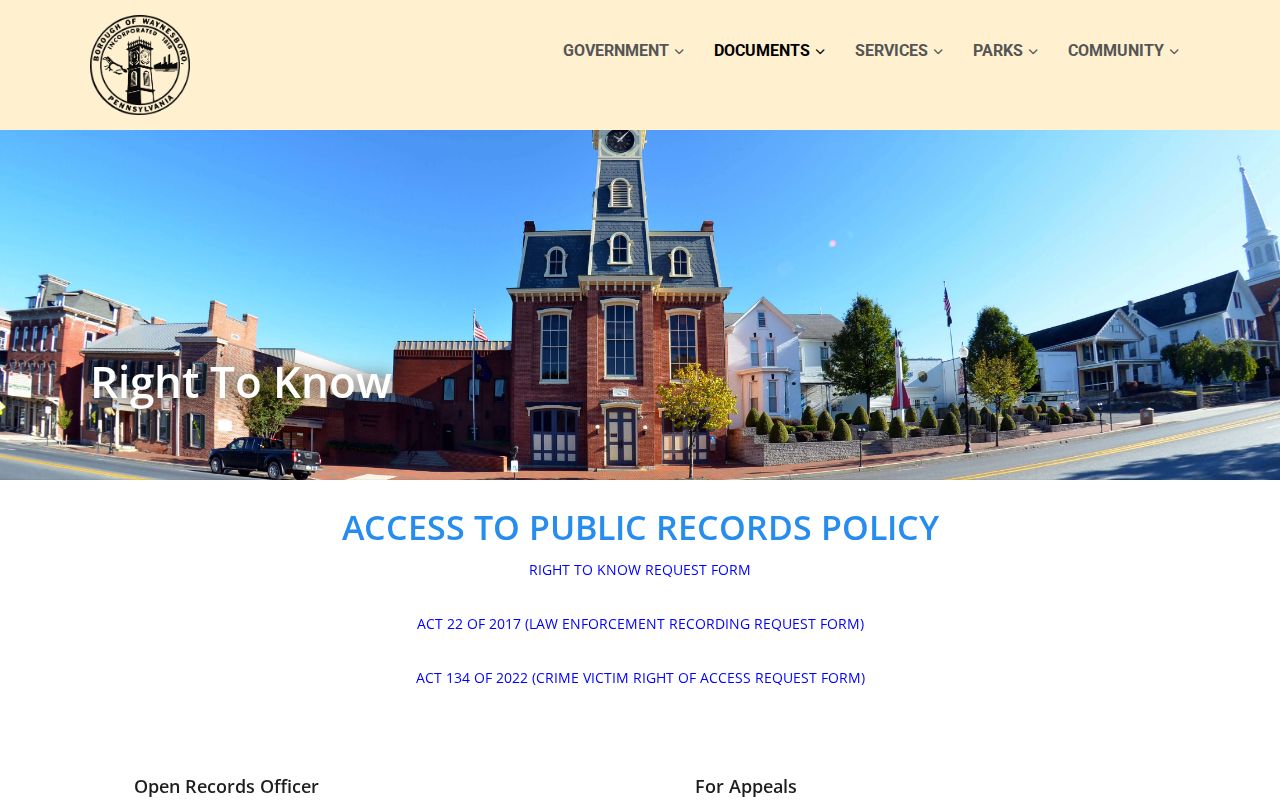
The form page shows the central split in local access: ordinary records use RTKL, but police audio and video use Act 22. Neither form replaces the court docket kept by the judiciary.
Records at the Waynesboro Police Department
Waynesboro Police creates the report and complaint for borough incidents. Those agency records do not automatically move into the MDJ or Clerk file. The court docket may identify the arresting agency and complaint number, but it summarizes prosecution rather than reproducing the officer narrative, witness material, or every item gathered during an investigation.
The research did not confirm a current direct police records phone or street address from the official department page, so the Borough's published Right-to-Know channel is the safe starting point. No verified Waynesboro police app or official online arrest blotter was found. Avoid similarly named third-party services.
Note: A public arrest does not make the complete investigative report public; Pennsylvania law permits agencies to withhold specified investigative information.
Waynesboro Police Oversight and Records
The official mayor's page states that Waynesboro's mayor oversees the Police Department and identifies officer shortages as a current local challenge. That is useful agency context, but it does not change custody of a specific file. Record requests still go through the Borough's official process, and court records still go to the assigned judicial office.
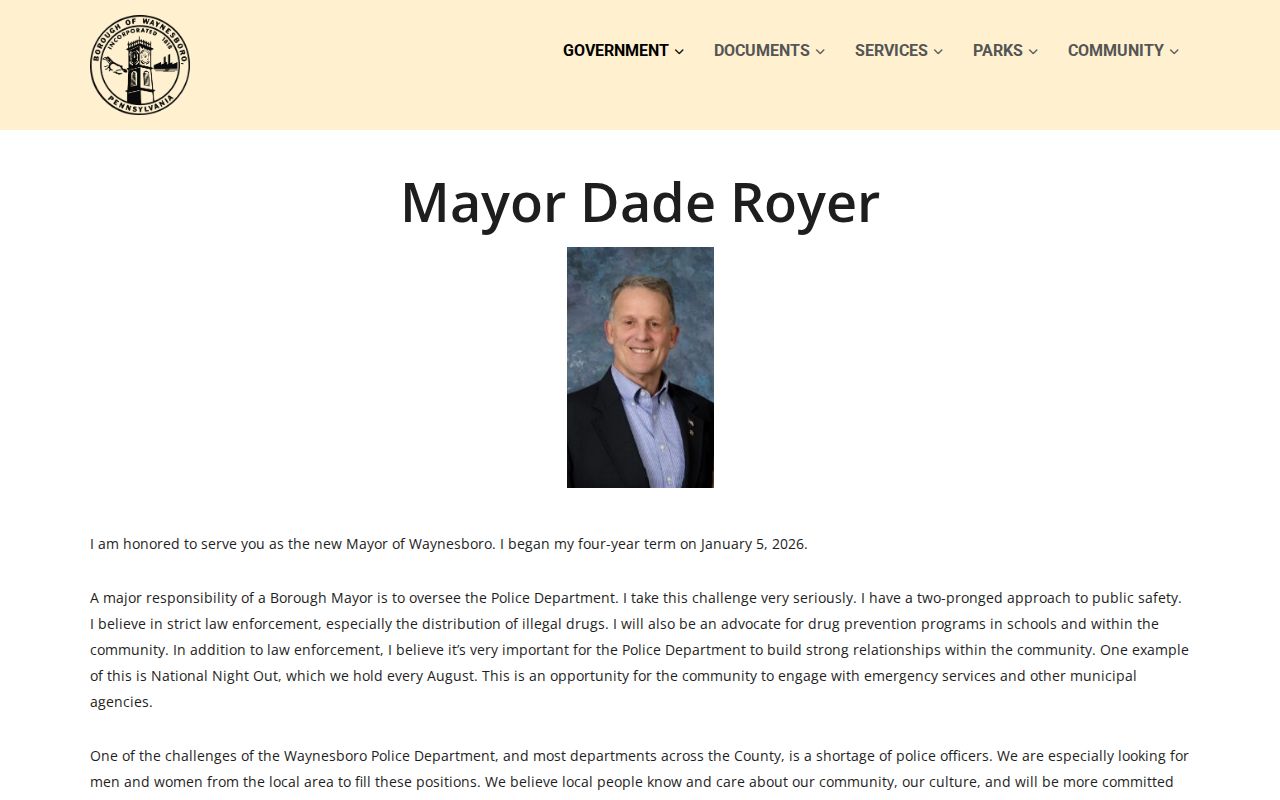
The mayor page helps identify the department's place in borough government. It should not be used as a case lookup or as proof about local crime levels.
Waynesboro publishes two separate request tracks because not every police record follows the same law. The standard Borough Right-to-Know form asks for requester contact details, a clear record description, relevant dates, and whether inspection or copies are preferred. Police audio and video use the Act 22 form instead. That recording request calls for the agency, incident time and place, people involved, the recording sought, the requester's interest, and a signature. The official material directs Act 22 submissions through the required delivery channel and within the statutory request period.
Neither borough form replaces the court route. A Waynesboro complaint, bail decision, or preliminary hearing belongs with MDJ 39-3-02 at 22 North Oller Avenue. The office serves both Waynesboro and Washington Township, so the docket caption may reflect more than the borough name. A misdemeanor or felony held for court later receives a CP-28 record in Franklin County Common Pleas. Current county custody is checked with Franklin County Jail in Chambersburg. Keeping those custodians separate prevents an unanswered borough request from being mistaken for a missing Waynesboro criminal record.
The borough's southeastern location near Maryland makes the jurisdiction check useful. Search Franklin County and the assigned MDJ office, then compare the arresting agency and docket dates before treating a name match as the same Waynesboro case.
Booking and Arrest Records in Waynesboro
Waynesboro has no verified borough jail roster. When a borough arrest requires detention, the person is taken to Franklin County Jail in Chambersburg. Police hold the incident and arrest report; the jail holds intake and custody data. The booking file may include admission time, committing agency, holding charges, bail status, and a release or transfer date, subject to lawful limits.
No official Franklin County online booking log was located. Call the jail at 717-264-9513 for current custody, then ask how to request a narrowly described booking record. Provide the person's legal name, approximate admission date, Waynesboro Police as the arresting agency when applicable, and a complaint or docket number.
A jail stay is not a conviction. For the wider local custody chain, use the Franklin County arrest search.
Waynesboro Court Records on Oller Avenue
MDJ 39-3-02 sits at 22 North Oller Avenue, Waynesboro, PA 17268. The office phone is 717-762-9411 and fax is 717-762-9297. Its jurisdiction covers both Waynesboro and Washington Township. That shared geography matters because a local search limited to a borough label can overlook a docket caption tied to the township.
Magisterial District Court 39-3-02
22 N. Oller Ave.
Waynesboro, PA 17268
717-762-9411
Fax: 717-762-9297
The MDJ handles citations, complaints, preliminary arraignment, bail, and preliminary hearings. Search by participant or docket number and select the Franklin County MDJ office. Confirm the court and dates before treating a result as the same person.
The Waynesboro Municipal Court File
Waynesboro does not operate a municipal criminal court. Pennsylvania routes borough cases through Magisterial District Court 39-3-02. Summary matters can remain there. Misdemeanors and felonies that are held or waived for court move to Franklin County Common Pleas, where the Clerk of Courts maintains the later file.
| Court Name | Magisterial District Court 39-3-02 |
|---|---|
| Jurisdiction | Waynesboro and Washington Township |
| Case Types Heard | Citations, summary matters, complaints, arraignments, bail, and preliminary hearings |
| Case Lookup Channel | UJS Case Search or the Oller Avenue MDJ office |
| What the Docket Shows | Charges, grades, bail, events, status, and public dispositions |
| Common Pleas File | Franklin County Clerk of Courts at 14 N. Main St., Chambersburg |
The free UJS docket is a summary. Copies and underlying documents come from the office that keeps that stage of the case under its current access and fee rules.
Waynesboro Held-for-Court Records
“Held for court” means the MDJ found enough basis for a misdemeanor or felony charge to move forward. It does not mean the person was convicted. After that entry, the District Attorney may file a criminal information in Common Pleas, and the case receives a CP-28-CR docket number.
- MJ docket
- The record of the minor-court stage at Oller Avenue.
- CP-28 docket
- The Franklin County Common Pleas record after a qualifying case moves forward.
- Disposition
- The outcome recorded for each charge.
- Bail
- Release conditions or security, not a fine or finding of guilt.
Search both docket levels. A count may be dismissed at the preliminary stage, withdrawn later, resolved by plea, or tried. The charge line alone does not tell that story.
Central Court is another local handoff. Franklin County generally holds consolidated preliminary hearings on Tuesdays in Courtroom 6 at the Judicial Center, with a Thursday shift when Tuesday is a legal holiday. The issuing MDJ still matters because continuance requests go back to that office. A Waynesboro searcher may therefore need the Oller Avenue MJ docket, a Central Court event, and a later CP-28 docket to reconstruct one case.
How Waynesboro Records Reach the County
Waynesboro Police creates the agency file. MDJ 39-3-02 receives the complaint and handles bail and the preliminary stage. If charges proceed, Franklin County Common Pleas and the Clerk of Courts take over the county case. Courts report dispositions to the Pennsylvania State Police Central Repository, while the original police report remains with the Borough.
Record flow: Waynesboro Police › MDJ 39-3-02 › Franklin County Court of Common Pleas › Pennsylvania State Police Central Repository
The official Franklin County criminal justice overview illustrates the local court structure behind that route.
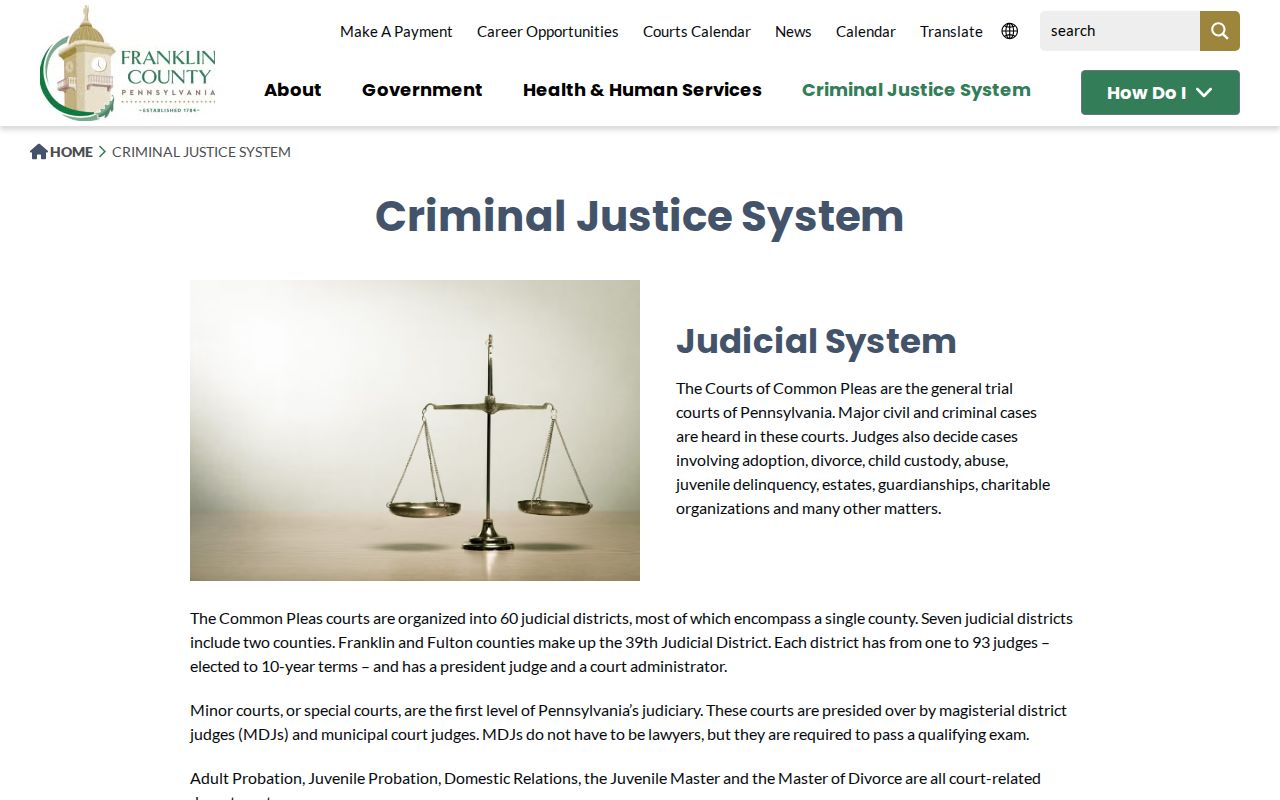
The county overview supplies structure, while the Oller Avenue office remains the city-specific court starting point.
Waynesboro Act 22 Record Requests
Waynesboro publishes a distinct Act 22 form for law-enforcement recordings. It asks for the requester, agency, incident date and time, location, people involved, the requested recording, the requester's interest, and delivery details. Research indicates that these requests generally must be made within 60 days of the recording event.
| Record | Use This Channel | Key Detail |
|---|---|---|
| Ordinary borough record | RTKL form | Describe the existing record and date range |
| Police audio or video | Act 22 form | Identify the event and exact recording promptly |
| Criminal docket | UJS or MDJ 39-3-02 | Use the name or docket number |
| Underlying Common Pleas file | Clerk of Courts | Use the CP-28 docket number |
Submitting the wrong form can slow the response. An Act 22 denial also has a different appeal route from an ordinary executive-agency RTKL denial.
Waynesboro Records and County Statistics
Waynesboro's official 2020 Census population was 10,951, making it Franklin County's second-largest incorporated borough. The borough lies near the Maryland line and forms a linked population center with Washington Township. That context helps explain why both areas share MDJ 39-3-02.
Franklin County's 2023 justice totals are countywide. They must not be presented as Waynesboro crime counts. A court workload figure can include cases from many agencies and places, and it may count cases rather than unique people. For a specific Waynesboro matter, the police agency, assigned MDJ, and docket identifiers are better evidence than a broad statistic.
The same care applies to population. Census counts provide a sound basis for identifying Waynesboro as a major borough, but population does not measure arrests or convictions. Local criminal-record research should remain tied to an official report, docket, or custody file.
Waynesboro and Washington Township also share a court office without sharing every police record custodian. Confirm the exact incident location and agency before filing a request. That small check can prevent a borough form from being used for a township or state-police record. It also helps the MDJ staff match the request to the correct complaint.
Waynesboro Record Access Rules
Waynesboro public access follows different rules for different custodians. Borough records use the Pennsylvania Right-to-Know Law. Criminal investigative information may be exempt. Police recordings use Act 22, and judicial files use the UJS Public Access Policy. PSP's dissemination law controls what appears in a central criminal-history product.
Key statutes and policies:
Pennsylvania Right-to-Know Law provides the process for requesting borough public records.
65 P.S. §67.708(b)(16) exempts specified criminal investigative information.
UJS Public Access Policy governs court case records and protected data.
18 Pa.C.S. §9121 limits dissemination from the state criminal-history repository.
An agency generally has five business days to grant, deny with a legal basis, or invoke a qualifying extension for an RTKL request. That response deadline is not a promise that every police record is releasable.